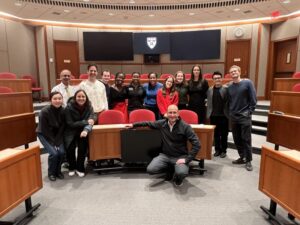
Harvard Business School has officially introduced a case study on WEVO into its curriculum, using it as a primary example of the transformation currently reshaping market research. Taught in Professor Rajiv Lal’s AI Marketing for Entrepreneurs and Enterprises course, the case dissects how WEVO’s synthetic audiences are moving from a novel experiment to a strategic necessity for global brands.
Here is why this milestone matters for the industry, and the core insights that emerged when future business leaders analyzed the technology with surgical precision.
Why HBS Chose WEVO: The Shift to “Co-Intelligence”
The case study, titled WEVO DRAFT, explores the tension every modern enterprise faces: the need for speed versus the need for accuracy. Traditional research is accurate but slow; early AI tools were fast but could lack reliability.
The HBS curriculum highlights WEVO’s unique position in resolving this tension through what the industry is calling “co-intelligence”- combining the speed of AI with the rigor of human validation. The class discussion centered on three critical pillars that executives and investors should watch:
- The Data Moat is the New Gold Standard: The students identified WEVO’s proprietary dataset – built from over 1 million human user studies – as a formidable competitive moat. In an era where commodity AI models are trained on the generic internet, WEVO’s ability to train agents on specific, validated human outcomes is what drives predictive accuracy.
- Trust is the Currency of AI: Synthetic audiences are only valuable if stakeholders trust the output. The case emphasizes WEVO’s “crawl-walk-run” approach to building trust: rigorously benchmarking Pulse (AI) against Pro (Human) results to prove reliability before scaling.
- Reducing the Risk of Innovation: The core value prop isn’t just faster data; it’s confidence. Whether for a product launch or a new campaign, the ability to predict customer behavior before a dollar is spent effectively de-risks innovation.
Three Lessons for Leaders in the AI Age
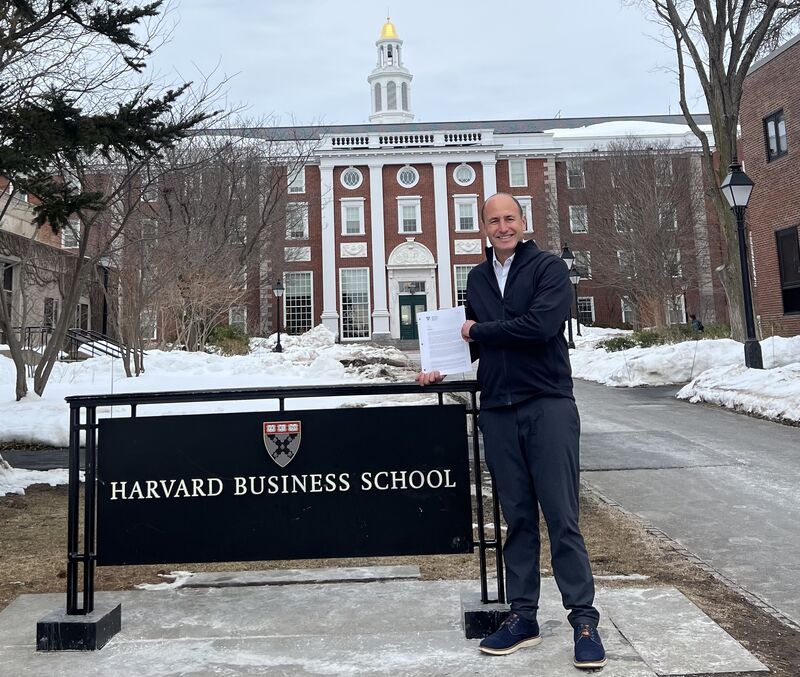
Beyond the business mechanics, WEVO CEO Nitzan Shaer shared three guiding principles with the HBS class that apply to any leader navigating the AI transformation:
- Fall in love with the problem, not the solution. Technology changes daily. The “pain” of not knowing how a customer will react to a new idea is eternal. Focus on solving that pain, not just on using the latest model.
- Don’t outsource your empathy. AI agents can execute tasks and predict reactions, but they cannot replace human judgment. The most successful leaders use AI to generate the what and how, but apply their own humanity to interpret the why.
- Build an experimentation machine. The companies that win won’t be the ones with the best initial ideas—they will be the ones with the fastest, cheapest loops for testing and validating those ideas.

What’s Next?
The inclusion of WEVO in the Harvard Business School curriculum signals a broader market truth: Synthetic user research has arrived. It is no longer an experimental edge case but a fundamental component of modern marketing and product development.
As the case study concludes, the future isn’t about choosing between human and AI insights—it’s about leveraging AI to scale the human voice, ensuring that every decision is customer-backed, instantly.
Read the Case: Copies of the case study are available for purchase on the Harvard Business Publishing website.
Experience the technology analyzed at Harvard.
Start your free trial of WEVO Pulse today or Contact Us to learn about our Enterprise solutions.